

Blockchain / DID
Blockchain Platform · DID/Wallet
META DID v2.0
K-BTF Decentralized Identity Platform
What is K-BTF?
K-BTF (Korea Blockchain Trust Framework) is a data and trust interoperability system for blockchain-based services established by the Ministry of Science and ICT (MSIT) and KISA. It resolves compatibility issues between distributed blockchain networks, enabling DIDs and digital credentials to seamlessly interoperate across different service environments.
Interoperability
Cross-Network Compatibility
Ensures compatibility across fragmented blockchain networks per service, enabling seamless DID and VC interoperability in any environment.
SSI
Self-Sovereign Identity
Based on the SSI model where individuals directly manage their own identity information and credentials, minimizing unnecessary collection of personal data.
PKI
PKI-Based Tamper Prevention
PKI cryptographic signatures recorded on the blockchain allow instant verification of credential authenticity, making document forgery structurally impossible.
Global
Global Compatibility
Compliant with W3C DID/VC and Open Badges 3.0 specifications, ensuring compatibility with diverse service environments both domestically and internationally.
Challenges Facing Public Agencies — Solved by META DID v2.0
From civil complaint processing to system adoption and credential management — we've identified the real-world challenges public agencies face.
Repetitive personal data collection for every service
Citizens must repeatedly submit ID copies and personal information each time they use a service, while agencies bear the risk of storing and potentially leaking this data.
Personal information is verified only once during VC issuance. Subsequent service usage is processed through signature verification alone, reducing the agency's data storage burden.
High cost of building a proprietary DID system
Building an in-house system requires hundreds of millions in initial costs, dedicated personnel, and ongoing maintenance. Security certification alone takes over 6 months.
With the K-BTF shared infrastructure SaaS model, agencies can start with just API integration — no separate build required. Key certifications like CSAP are already completed.
Difficulty verifying digital certificate authenticity
PDF or image-based digital certificates are difficult to verify for tampering on the spot. The current system relying on visual inspection has inherent reliability limitations.
PKI-based VCs recorded on the blockchain enable instant verification of issuer signatures. The system automatically confirms whether tampering has occurred.
Long timelines and high costs for security certification
Mandatory certification procedures such as CSAP and Privacy Impact Assessment alone take over 6 months for public system adoption. Service deployment is impossible until certification is complete.
META DID v2.0 has pre-completed CSAP, PIA, TTA performance testing, and vulnerability assessments. Adopting agencies can start immediately without separate certification procedures.
How Public Agencies Use It
Each agency doesn't need to build its own DID infrastructure. They jointly utilize the K-BTF shared infrastructure in a SaaS model. Agencies can start services with just API integration on top of a K-BTF-compliant environment.
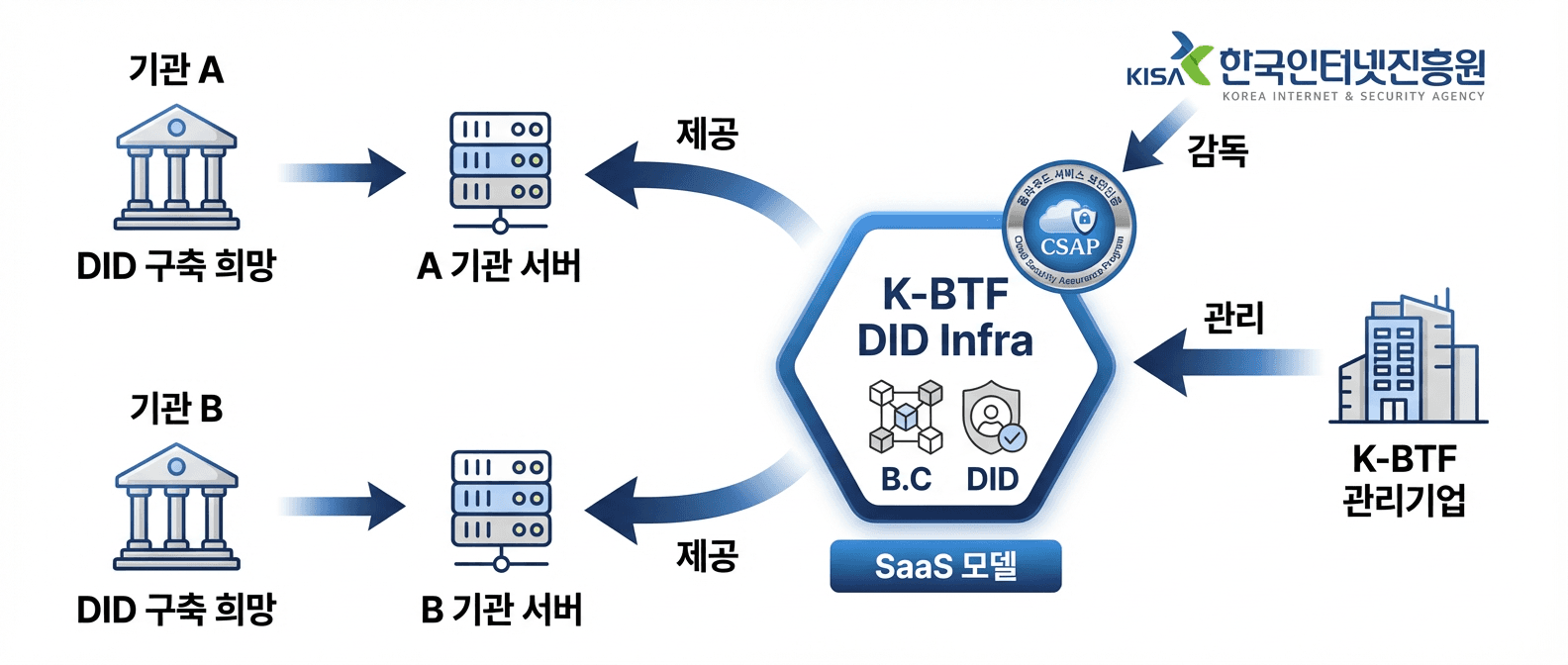
No Separate Build Required
Agencies don't need to build their own blockchain or DID servers. Simply connecting to the K-BTF shared infrastructure is sufficient.
Shared SaaS Model
K-BTF DID infrastructure provides blockchain and DID services as SaaS. Agencies connect instantly via API integration with zero build costs.
K-BTF Framework Compliant
Designed in compliance with the K-BTF framework established by MSIT and KISA. A pilot-verified environment ensures stable service operation.
DID Service Flow
A three-party structure of Issuer, Holder, and Verifier enables identity and credential verification without exposing personal information.
K-BTF VC Issuance & Verification Flow
DID Registration
Users and agencies register DIDs and public keys on the blockchain
VC Issuance
Issuer creates digital credentials upon user request
Wallet Storage
Identity information is securely stored in a personal digital wallet
VP Submission
Only selected information is presented to the verifier
Verification
Issuer signature is instantly verified using public keys on the blockchain
Use Cases
Applicable across various environments from public services to internal enterprise systems.
Remote Identity Verification
Real-time identity verification for civil complaints and subsidy applications
Public Facility Access
QR/gate access management for government buildings, libraries, and sports facilities
Training Certificates
Digital certificate issuance for public servant training and safety education
Internal 2FA Login
DID-based secondary authentication for work portals and groupware
Digital Signatures & Approvals
PKI digital signature for contracts and internal approval processes
Mobile Employee ID
Attendance and in-house authentication via mobile DID
Pre-Completed Certifications
All security verification items required for public agency adoption have been completed in advance for rapid deployment.
Get Started Immediately —
No Certification Required
Key security certifications and verifications, including CSAP, have been pre-completed, reducing the certification burden for adopting agencies. API-based integration enables quick connection with existing systems.
- KISA K-BTF Pilot Verification
- CSAP (Cloud Security Assurance Program)
- Privacy Impact Assessment (PIA)
- TTA Performance Testing
- Smart Contract Security Audit
- Vulnerability Assessment (Source Code / Web Penetration / CCE / CVE)
Contact Us
Connect with your existing systems quickly via API integration.
Feel free to reach out with any questions.